Many B2B businesses struggle to generate qualified leads even after investing in ads, outreach, and multiple marketing channels. The main reason is that B2B buyers don’t make quick decisions; they research, compare solutions, and look for brands they can trust before making a purchase. If your business isn’t providing helpful content during this research stage, potential clients may choose your competitors instead.
This is where a strong Business-to-Business content marketing strategy becomes important. In simple terms, Business-to-Business content marketing uses strategic and valuable content to attract other businesses and promote products or services effectively. Instead of direct selling, it focuses on educating your audience, building trust, and establishing your brand as a reliable industry authority.
In this guide, we will explain B2B Content Marketing Strategy, what it is, why it matters, how to build an effective strategy, and the key mistakes you should avoid.
Why is B2B Content Marketing Essential?
- Prolonged B2B Purchase Decision-making processes need Educational Information: Business-to-Business purchases have multiple decision-makers and longer purchase decision-making cycles, therefore, the educational information will assist them to go through the entire research process.
- Developing Brand Authority and Trust: Becoming a content producer of valuable and insightful content on a regular basis establishes a company as an expert in a specific industry and creates credibility in the eyes of prospective customers.
- Creation of High-Quality Leads: Purposeful content will attract businesses in the process of actively seeking a solution, which will turn out more qualified and ready to convert leads.
- Providing Sales Teams with Content of Value: The resources such as case studies, product guides, and white papers enable Sales Teams to answer questions of customers and reinforce their pitches.
- Improving SEO and Organic Visibility: Search engine optimization improves the ranking of content in search engines, increases website traffic, and helps businesses reach potential customers organically. Investing in professional SEO services can further strengthen your online visibility and long-term growth.
Features of a Successful B2B Content Marketing Strategy
- Good Business and Marketing Objectives: A good strategy will begin with clear objectives such as building brand awareness, generating leads or receiving better customer reaction.
- Understanding the Target Audience: You will know what is going on with the problems, needs, and preferences of your audience and, thus, will be able to provide the content that can directly address the problems of the audience.
- Developing Detailed Buyer Personas: Drawing up detailed buyer personas can assist the marketer to personalize the content to be used to specific decision-makers and their position in an organization.
- Effective Brand Messaging and Positioning: The same brand messaging should make all messages specific to the company’s values, expertise, and value proposition.
- Content Distribution Strategy: The effective distribution strategy will help the company project the content to the appropriate audience by leveraging marketing tools such as SEO, email, and social media.
Understanding the Business-to-Business Buyer Journey
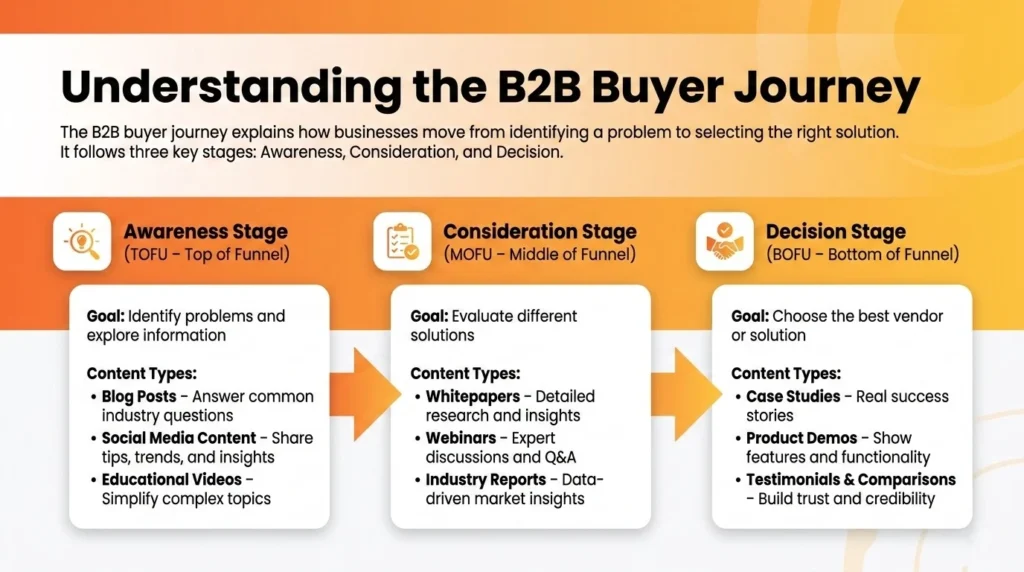
Business-to-Business buyer journey is a concept that explains the way business organizations go through prior to buying a commodity or service. It usually involves three steps, awareness, consideration and decision and each of these steps needs various forms of content in order to influence potential buyers to make an informed decision.
Awareness Stage (Top of Funnel – TOFU)
- Blog posts: Post useful information, and address the popular questions in the industry.
- Social content: Posts tips, trends and updates to build brand awareness.
- Educational videos: Educate the complicated issues in an entertaining and comprehensible manner.
Middle of Funnel (MOFU)
- Consideration stage: In the consideration stage, the buyers start evaluating the various solutions, and which one suits them best. This content is more based on deeper insights and showing expertise.
- Whitepapers: Provide an in-depth study and examination of industry issues and remedies.
- Webinars: present interactive forums in which professionals give their knowledge and respond to questions.
- Industry reports: Current numerical data that enable the buyer to have a better understanding of the market trends.
Decision Stage (Bottom of Funnel -BOFU)
During the decision stage, the buyers are willing to choose a solution and to pick the most appropriate vendor. The content must aim at developing trust and showing actual results.
- Case studies: Present actual examples of how the product or service resolved the problem of a client.
- Product demos: Display features and how the solution works.
- Testimonials and comparisons: Offer social proof and emphasize the benefits of the product compared to the competitors.
Types of Content Used in B2B Marketing
B2B firms adopt varying content formats to inform potential consumers, gain credibility and lead the consumer through the buying process. All forms of contents are beneficial and have a purpose of assisting businesses to convey valuable information to decision-makers.
- Blog Articles: The blog articles are informational posts, which are focused at solving issues in the industry, offer solutions and enhance visibility of the web site by search engine optimization (SEO).
- Whitepapers and Research Reports: Whitepapers and research reports include detailed analysis, industry statistics, and professional opinion that assists business to know about complicated issues and possible resolutions.
- Case Studies: Case studies are real-life illustrations of how a company assisted a client in resolving an issue, which gives a demonstration of experience and positive outcomes.
- Infographics: Infographics are a visual way of presenting data, statistics or processes effectively in a format that can be understood easily thereby making complex data more interesting and sharable.
- Webinars and Podcasts: Webinars and podcasts enable businesses to broadcast professional and industry-related discussions and tips in a more interactive or conversational style.
- Educational Videos: Products, services or industry videos are presented in a simple and interesting manner and the audience can grasp the important information within a short time.
- Email Newsletters: The email newsletters assist the business to maintain contact with its audience through communication of updates, insights, and useful resources to them with the end result being in their inbox.
- Interactive Content (Quizzes, Tools, Calculators): Quizzes, ROI calculators, and the evaluation tools represent interactive content that promotes the involvement of the audience and offers customized insights.
Step-by-Step Guide to Build a B2B Content Marketing Strategy
Creating an effective Business-to-Business content marketing framework is something that needs to be planned, thoroughly analyzed, and constantly made better. A systematic approach can enable businesses to generate useful content that will appeal to potential customers, build trust, and also help it grow in the long-term.
Step 1: Set Your Content Marketing Objectives.
Begin by having specific objectives which are in line with your business objectives. They can be creating brand knowledge, qualified leads, web site traffic, or resource support of sales teams.
Step 2: Research Your Target Audience.
Know your dream customers, their problems, likes and dislikes and their buying behaviour. This will assist you in developing content that will directly appeal to their needs and interests.
Step 3: Process Competitive Analysis.
Study the content strategies of your competitors to see what is getting read, to which formats are succeeding, and what is missing in terms of what you can provide a better or more valuable account of in your business.
Step 4: Perform a Content Audit
Look through your current material to see how it is doing and what its relevance is. This can be used to determine the high performing content, expired resources and areas of improvement or revision.
Step 5: develop a Content Calendar.
Create a content calendar with plans on what to write, how to write and when to publish it. This is to maintain regularity in content production, as well as, aligning content and marketing campaigns, and business objectives.
Step 6: Create Good Content.
Pay attention to the development of well-researched, informative, and engaging content that can really bring good value to your audience and make your brand a specialist in the industry.
Step 7: Content Distribution and Promotion.
Use different platforms like search engines, social media sites, email marketing and industry web pages to distribute your content to more people.
Step 8: Measure and Optimize Performance.
Monitor the most important indicators like traffic to the site, rates of engagement, leads, and conversions. Apply these lessons in order to work on your approach and further optimize the content in the future.
Best Content Distribution Channels for Business-to-Business
The decision on the distribution channels also assists the businesses to make sure that their content is available to the proper audience and produces meaningful interactions.
- SEO and Organic Search: Search engine optimization encourages companies to get the high intent traffic which comprises people searching actively in search of solutions.
- LinkedIn Marketing: LinkedIn has been among the most useful B2B marketing tools where companies get access to professionals and decision-makers.
- Email Marketing Campaigns: Email campaigns can be used to cultivate the leads by discharging valuable material, updates, and personalized messages to subscribers.
- Guest Blogging and Industry Websites: Writing on industry websites or guest blogs would increase the reach and credibility of a niche.
- Paid Advertising and Sponsored Content: Sponsored posts, display advertisements, and search advertisements are the forms of paid promotion that assist in increasing the visibility of the content and in reaching the target audience.
- The Influencer and Partnership Marketing: Cooperation with the industry professionals and partners assists the companies in attracting new customers and establishing brand control.
Measuring B2B Content Marketing Success
The performance tracking of business assists the business in knowing whether or not its content strategy is attaining its objectives and producing quantifiable outcomes.
Key Performance Indicators (KPI)
- Traffic on the website: This is the measure of visitors to your site with content.
- Lead generation: Monitors the number of prospective customers who submit their contact details or request information on what you can give them.
- Conversion rates: Refers to the number of visitors who are able to complete intended tasks, including the signing up, content downloading, and buying process.
- Engagement metrics: This involves measures such as time on page, shares, comments, and click through, which indicate the level of interaction of audiences with content.
Important Analytics Tools
- Google Analytics: Aids in monitoring traffic and the actions of the users, as well as the performance of the content pages.
- HubSpot: Offers marketing automation, tracking of leads, and performance of a campaign.
- SEMrush / Ahrefs: It could be used to conduct key research, analyze the SEO and track the backlinks as well as view competitor information.
Common Mistakes to Avoid in B2B Content Marketing
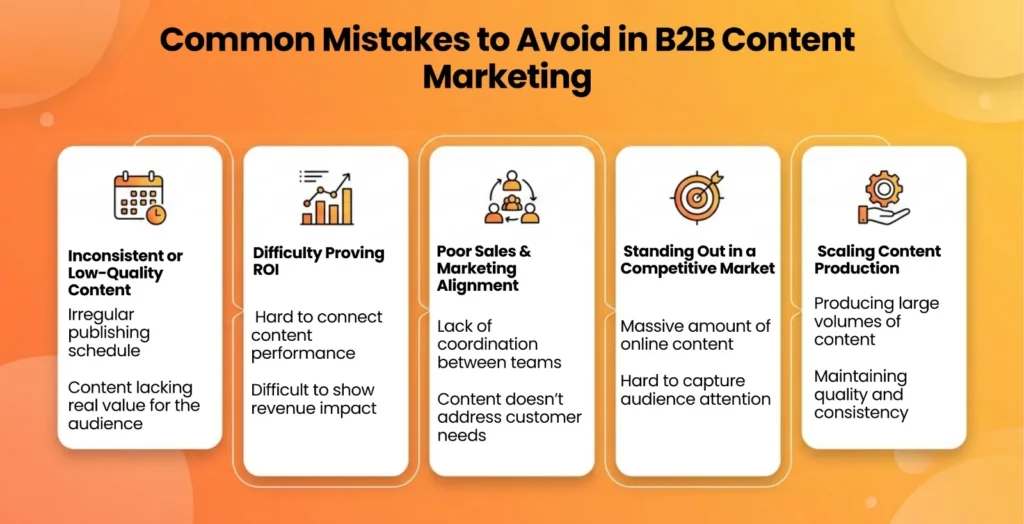
The inability to handle content marketing is a problem faced by many businesses because of the strategic and operational problems that make the campaigns less effective.
- Creating quality regular content: A lot of companies do not have a regular schedule of publication or create valuable content that would suit the audience.
- Proving ROI to Stakeholders: It is not always easy to relate content performance to revenue, which makes it hard to prove the worth of content marketing.
- Sales and Marketing Team Alignment: In case of the lack of alignment between sales and marketing teams, the content might not answer actual questions and needs of customers.
- Striking a Chord in a competitive market: Daily content being published in large loads means that businesses need to come up with unique and valuable content so as to draw attention.
- Scaling Content Production: Many organizations may find it challenging to produce mass content of high quality at the same time, as well as sustain quality and consistency.
B2B Content Marketing Trends
The Business-to-Business content marketing environment is still being transformed with improved technologies and behavioral patterns of the audience defining how a business should interact with their customers.
- Artificial Intelligence-Helped Content: The artificial intelligence tools assist a marketer to generate, analyze and produce content more effectively.
- Hyper-Personalized Content: Industry-specific, company or decision-maker tailored content will drive more engagement and conversions.
- Engaging and Virtual Content: The interactive content in the form of quizzes, tests, and calculators promote the involvement and further engagement.
- Video-First Content Strategy: Video content is ever-popular as it is considered an exciting means of presenting complicated concepts and demonstrating products.
- Account-Based Marketing: ABM is aimed at producing the most specific content that can be delivered to specific companies or decision-makers to work on the rate of conversion.
Best Practices for Business-to-Business Content Marketing Success
Best practices would assist businesses to ensure that their content marketing strategies are optimized.
- Focus on Value, Not Promotion: Produce materials that educate and are problem-solving as opposed to mere promotion of products or services.
- Rediscover Content in the Channels: Recycle material in various forms, e.g., convert blog posts into video, infographics or Facebook posts.
- Hold regular publications: The frequent release of content enables one to keep their audience active and enhance their visibility in search engines.
- Tell Storytelling to enhance Engagement: Storytelling allows making content more relatable and memorable, which allows the audience to connect better with the brand.
- Never-Ending Analysis and Self-Improvement: Conducting periodic reviews of performance data assists businesses in refining their strategies and enhancing future campaigns.
Conclusion
Business-to-Business content marketing has evolved as a critical initiative for organizations that want to build credibility, generate qualified leads, and support long sales cycles. A well-planned B2B content marketing strategy helps businesses create and distribute valuable content that attracts the right audience and builds trust over time. By producing useful and informative content, companies can educate potential buyers and guide them through every stage of the purchasing process.
B2B content marketing is successful when it is planned, executed, and improved. To realize significant outcomes, businesses need to know their audience, create quality content, and share them using the appropriate channels.
With the digital transformation still transforming the Business-to-Business world, the more companies are value-driven and content and information-driven, the more they are likely to grow in the long term. Organizations can build strong customer relationships, build brand authority, and realize sustainable business success through investing in effective content marketing practices.
FAQs
1. What is B2B Content Marketing?
The book is the creation and delivery of valuable content to appeal to, engage, and convert business customers to win their business.
2. Which Content is most Effective in Business-to-Business Marketing?
The most effective content formats are blog posts, whitepapers, case studies, webinars, videos and industry reports.
3. What is the Time to See the Results of B2B Content Marketing?
The outcomes are usually achieved after several months because content marketing is based on the establishment of trust and long-term relationships.
4. What is the Platform that is Most Suitable in Business-to-Business Content Distribution?
Some of the best platforms are LinkedIn, search engines, email marketing, and industry websites.
5. What is the Measurement of Success of B2B Content Marketing?
Some of the measurement metrics applied to measure the success include website traffic, lead generation, engagement rates, and conversion rates.