Social media has become one of the most powerful channels for brand growth and visibility. Today, more than 5 billion people actively use social media worldwide, and millions of users spend hours every day on platforms like Instagram, Facebook, LinkedIn, and TikTok. With such massive daily activity, social media offers an incredible opportunity for brands to connect with their audience and grow faster.
However, many businesses still struggle to get real results. Even after posting regularly, their reach, engagement, and followers don’t grow the way they expect. The biggest reason is the lack of a clear social media campaign strategy. Random posts rarely create impact. If your brand is not growing or dominating social media, it often means your brand visibility and awareness are still weak on social platforms.
The reality is that today almost every successful brand runs social media campaigns to expand reach, build trust, and stay ahead of competitors. From creative storytelling to viral challenges and user-generated content, brands are using smart campaigns to capture attention and drive engagement.
In this guide, we’ll explore some powerful social media campaign examples that helped brands increase visibility, boost engagement, and achieve real marketing results. These examples will help you understand what makes a campaign successful and how you can apply the same strategies to grow your brand on social media.
Top Features of Social Media Campaign.
1. Well-defined Campaign Objectives:
- An effective campaign starts with well-defined objectives like brand awareness, engagement or conversions.
- For Example: A skincare brand launches a new product and runs awareness videos and influencer posts on Instagram to introduce it to a wider audience.
2. Specified Target Audience:
- Targeting the correct audience will make sure that the campaign message is received by the people who have the highest probability of engaging or acting.
- For Example: A fitness brand targets gym enthusiasts aged 18–35 who follow workout content on Instagram.
3. Effective Creative Idea:
- A distinctive and striking concept will make the campaign stand out and will be remembered among the popular social feeds.
- For Example: A clothing brand starts a #StyleYourWay challenge where users share outfits using the brand’s products on Instagram.
4. Planning of Strategy Content:
- It entails strategic organisation of the content in terms of the type of content to be posted, dates of publication and type of platforms to be used to enhance campaign development.
- For Example: A tech brand promotes a new gadget with teaser posts, demo videos, and reviews on YouTube and Instagram.
5. Performance Measurement:
- Monitoring the indicators such as reach, engagement and conversions assists in measuring the effectiveness of a campaign and outlining future measures.
- For Example: A brand tracks likes, clicks, and conversions using analytics on Facebook.
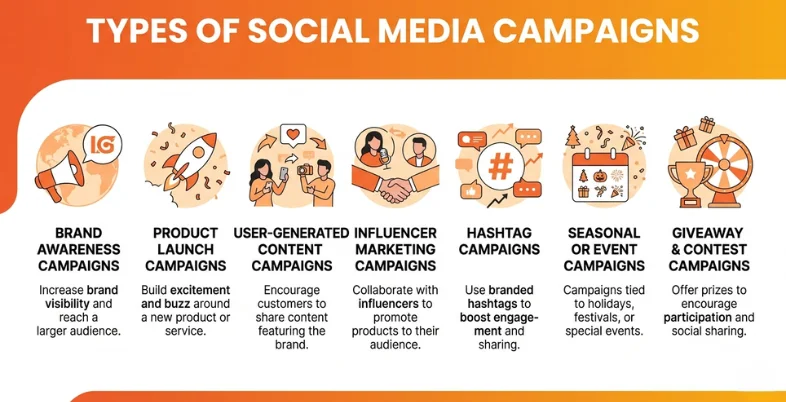
Types of Social Media Campaigns
1. Brand Awareness Campaigns
The purpose of these campaigns is to increase the visibility of the presence of a brand and its popularity in more people on social media. Symbolically, the Airbnb Live There campaign encouraged the traveller to find the spots where the locals live and this enabled the brand to gain recognition globally.
2. Product Launch Campaigns
The product launch campaigns create a buzz around a new product or services, pre and post-launch. Apple’s iPhone launch campaigns are one such example, as they are likely to generate massive buzz through the release of teaser posts, videos, and collaboration with influencers.
3. Campaigns of User-Created Content
Such campaigns encourage customers to create and share content that contains a brand or a product. A case in point is the popular Apple campaign, the #ShotOniPhone campaign, in which users post photographs that they have taken on the iPhone.
4. Influencer Marketing Campaigns
Brands help influencers to advertise products to their followers. As an example, Dunkin partnered with Tik Tok social media influencer Charli D’Amelio to create a drink that was called The Charli, which sold in bulk.
5. Hashtag Campaigns
The hashtag campaigns are created in order to motivate users to share content through the use of a specific hashtag in order to enhance engagement. To illustrate, Chipotle developed the GuacDance and it requested individuals to share videos of dancing in honour of guacamole.
6. Seasonal or Event-Based Campaigns
These campaigns will be done along with the holidays, festivals or special events. Using the example of the holiday cup campaign of Starbucks, there is a buzz which is created in the Christmas season each year.
7. Giveaway and Contest Campaigns.
These campaigns do offer prizes to attract people to join the campaigns and share. As an example, many brands that have Instagram giveaways promotion ask people to follow the page, like a post and invite friends to participate in the giveaway.
Advantages of Social Media Campaign
- Between Brands and Customers: Social media campaigns will allow the brands to cover more individuals and become popular in different platforms.
- Improved Customer Dynamics Customer: Interactive campaigns will encourage individuals to like, comment, share and interact with the brand in an active mode.
- Greater Conversion Opportunities. Careful strategies will guide the possible consumers to the action, which could be subscribing, purchasing, or visiting a site.
- More Brand Loyalty: Ongoing and appealing campaigns create stronger relationship and trust with the existing customers.
- Greater Audience Intelligence Campaign analytics assists in providing valuable data relating to the audience behaviour, preferences, and engagement patterns.
Suggested Read: B2B Content Marketing Strategy
Step-by-Step Social Media Campaign Planning Process
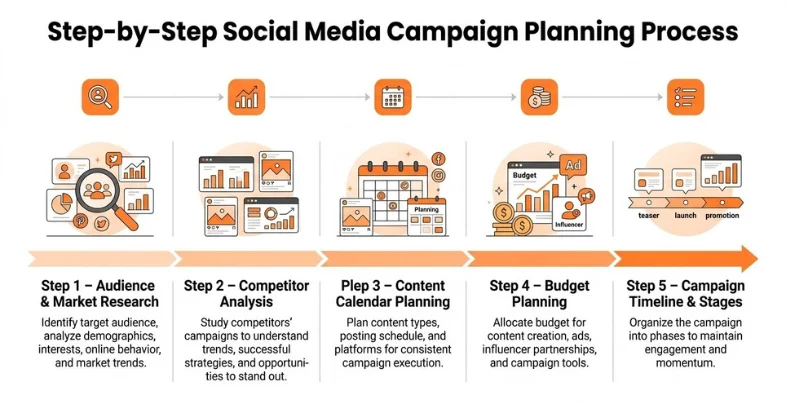
To run a successful social media campaign, a clear and well-planned strategy is essential. Proper planning ensures that the right message reaches the right audience at the right time, maximizing engagement and campaign results. Below are the key steps involved in planning an effective and results-driven social media campaign.
1. Viewing Research and Market Analysis
The initial one is to know who your target audience is through studying their demographics, interests, what they do online and what their favourite social sites are. Companies also examine the market trends and the needs of the customers so as to come up with relevant and attractive campaigns.
2. Competitor Campaign Analysis
Brands study the activities of their rivals on social media before embarking on a campaign. This assists in determining how successful and trending formats and gaps can be utilised to develop an even more effective and unique campaign.
3. Content Calendar Planning
After understanding the strategy, marketers prepare a content calendar that will contain the type of content that will be published, the timing when it will be posted, and the platforms on which it will be posted. This will provide uniformity and systematised campaign implementation.
4. Budget Planning
The campaign budgets will include the content creation, influencer partnerships, cost of advertising and campaign management tools. The budget is clear and efficient in allocating the resources.
5. Campaign Timeline and Stages
Lastly, there are stages of campaigns like teaser phase, launch phase, and after-sales promotion. This is a strictly planned timeline that assists in keeping the pace and using the audience’s potential to the full.
List of Best Social Media Campaign Examples
1. Barbie Movie Selfie Generator
Barbie Movie Selfie Generator was introduced prior to the release of the movie in 2023 to create hype and interactions between the target market and fans. The campaign came up with an artificial intelligence-driven application that enabled people to post their pictures and convert them into customised Barbie-style film posters.
Individuals were able to personalise their tagline and background such that it was as though they were a part of the movie promotion. Those posters were widely spread on platforms such as Instagram, TikTok, and Twitter, which made the campaign viral and brought awareness of the film to a large extent.
Key Strategy:
- Interactive Technology: The campaign involved AI-based tools, which enabled users to make their own poster, and this made the campaign interactive.
- User-Created Content: Fans posted their own customised posters on social media, which made them promoters of the film.
- Celebrity Participation: The celebrities and influencers also participated in the tool, motivating more users to use it.
- Visual Appeal: Bright pink graphics and trademark branding of Barbie meant that the posters were recognisable.
- Easy Sharing: The posters that were created were optimised for social media, and therefore, they could be shared immediately.
Key Takeaway:
- Interactive campaigns involve active participation by the users instead of passively viewing content.
- Individual experiences enhance user sharing and interaction.
- On social sites, content that is visually appealing does better.
- Organic reach is increased by encouraging user-created content.
- Beautiful online tools can be used to make campaigns viral.
2. Coca Follicle Happy Tears Campaign
The campaign that Coca-Cola initiated as part of the Random Acts of Kindness Day is called Happy Tears. The campaign was centred on emotional narratives of people who caused others to shed happy tears by showing kindness to them.
It also invited influencers and social media users to nominate a person with whom they had a positive influence in their lives. Coca-Cola even published limited-edition kits of tissues, beverages and feel-good stories.
Key Strategy:
- Emotional Storytelling: The campaign emphasised heartwarming stories, which touched the hearts of the audience.
- Influencer Marketing: TikTok creators and influencers assisted in getting the campaign viral.
- User Participation: The participants were advised to nominate people who inspired them.
- Limited-Edition Products: Exclusive kits were exciting and urgent.
- Hashtag Promotion: Branded hashtags enable the sharing of stories easily.
Key Takeaway:
- Emotional campaigns establish better connections with the audience.
- The promotion of storytelling makes the audience more involved.
- Influencers assist in spreading the campaign in a fast manner.
- Limited products cause a sense of urgency and buzz.
- Brand perception is made better with positive and uplifting campaigns.
3. Tinder It Begins With a Swipe Campaign
Tinder initiated this campaign to call attention to life-based success stories of people coupled with the platform. The campaign did not only emphasise casual dating, but it also depicted real relationships that started with a swipe. The posts on social media, influencer collaborations, and video stories helped Tinder have an example of how meaningful relationships can be formed with the help of its app.
Key Strategy:
- Real User Stories: The use of real couples aided in building realism.
- Influencer Collaboration: Influencers posted their experiences of using the app on social media.
- Good Brands: What the campaign did was change the perception of Tinder to meaningful relationships.
- Cross-Platform Promotion: The content was made on various social media platforms.
- Relatable Content: Stories were relatable to the younger demographics.
Key Takeaway:
- True life stories contribute to building trust among audiences.
- True customer experience builds brand credibility.
- Brand perception can be redefined using positive messaging.
- The influencers are used to target younger audiences.
- Campaigns that are memorable are told emotionally.
4. CeraVe “Michael CeraVe” Campaign
CeraVe designed a viral campaign in which actor Michael Cera was the secret behind the brand. The campaign tended to imply that Michael Cera was the creator of the skincare brand through parody posts on social media and fake appearances. It was a campaign that generated curiosity during the weeks prior to the truths being unveiled in a Super Bowl advert.
Key Strategy:
- Humor-Based Marketing: The advertisement employed ridiculous humor in order to draw attention.
- Celebrity Involvement: Michael Cera, an actor, was brought in to be the face of the story.
- The mystery storytelling: The brand gradually disclosed hints on social media.
- Multi-Platform Promotion: The campaign was present on TikTok, Instagram, and podcasts.
- Big Reveal Event: The ad closure was a Super Bowl ad.
Key Takeaway:
- Campaigns that are humorous are very shareable.
- Hypothesis-based narration develops interest and expectation.
- There is increased credibility and reach through celebrity partnerships.
- Multi-platform campaigns gain attention.
- A good final disclosure can increase the impact of the campaign.
5. Spotify Wrapped Campaign
Spotify Wrapped is a yearly campaign that presents users with individualised information concerning their music listening patterns during the year. The statistics provided to the users include their favourite songs, favourite artists, and hours spent listening. The results are presented in aesthetically captivating social shareable graphics.
Key Strategy:
- Data Customisation: Every user will get custom listening data.
- Shareable Graphics: Visually attractive slides motivate users to share results.
- Community Engagement: Fans are able to compare their music preferences online.
- Annual Tradition: This is an annual campaign that creates anticipation.
- Cross-Platform Sharing: The share of results is easy to share across various platforms.
Key Takeaway:
- Individual experiences enhance activity.
- The use of data to drive campaigns generates interest among users.
- Viral images enhance free publicity.
- The long-term brand traditions are created through annual campaigns.
- Social sharing may make customers brand promoters.
6. Apple Shot On iPhone Campaign
Apple has also created the campaign on Shot On iPhones to demonstrate the power of iPhones in taking photographs. The hashtag was used to invite users to post photos they had taken using their devices. The best photos were subsequently used by Apple in adverts and billboards around the world.
Key Strategy:
- User-Generated Content: Customers generated content that demonstrated the product.
- Hashtag Marketing: The hashtag simplified content tracking and sharing.
- Community Partnerships: Photographers all over the world participated in the campaign.
- Feature Showcasing: The company placed emphasis on the quality of the camera of the phone.
- Global Promotion: Global Ads had been used to showcase selected photos.
Key Takeaway:
- The content created by users enhances trust.
- When their content is featured, customers develop brand ambassadors.
- Hashtags are useful in structuring massive campaigns.
- Marketing is more relatable to the real user experiences.
- Brand loyalty is achieved through community-driven campaigning.
7. Ice Bucket Challenge Campaign
The Ice Bucket challenge was a viral campaign that was developed with the aim of creating awareness and funds to be donated to ALS research. The participants recorded videos of themselves pouring a bucket of ice water on their heads and nominated other people to do the same as they donated to the cause.
Key Strategy:
- Simple Participation Rule: Participation in the challenge was easy for anyone.
- Social Nomination: Here, members who had been nominated nominated friends to carry on with the chain.
- Involvement of the Celebrities: The celebrities assisted in distributing the campaign throughout the world.
- Cause-Based Marketing: The campaign sponsored ALS research.
- Viral Video Format: Short videos were not difficult to share on the internet.
Key Takeaway:
- Uncomplicated obstacles promote mass action.
- Campaign proliferation is promoted through social nominations.
- Emotional support is motivated by the cause campaigns.
- The presence of celebrities hastens the spread of the virus.
- The viral content can contribute greatly to the increase in awareness and donations.
8. Chipotle Guac Dance Guac Commercial
Chipotle used the hashtag GuacDance campaign on TikTok to promote National Avocado Day. The brand managed to motivate users to share videos of dancing that demonstrated their affection towards guacamole. The challenge took a viral shape in no time and produced thousands of user videos.
Key Strategy:
- Trending TikTok Format: The campaign relied on the popularity of dance challenges on the site.
- Branded Hashtag: The hashtag of participation was GuacDance.
- Influencer Collaboration: TikTok creators assisted in the launch of the challenge.
- Engaging and entertaining Content: The campaign centred on the entertainment and not promotion.
- Limited-Time Offer: Chipotle provided free guacamole to attract customers to the program.
Key Takeaway:
- By capitalising on the trends of platforms, more is involved.
- Younger people are drawn to fun and entertaining campaigns.
- Influencers will enhance the campaign coverage.
- Campaigns are facilitated by branded hashtags.
- The use of promotions and entertainment increases participation.
How to Create Your Own Social Media Campaign
- State Your Campaign Objectives: Specifically state what you wish to accomplish, whether it is brand awareness, engagement or sales.
- Know Your Target Audience: Learn the interests, demographics and online behaviour of your audience to develop campaign content that is relevant to them.
- Select the Right Platforms: Select the social media platforms that your target audience is highly active in.
- Develop a Campaign Concept to be Creative: Design a theme, story or hashtag that the campaign is remembered by.
- Produce interesting materials: Utilise attractive graphics, videos and interactive posts that will draw the audience.
- Collaborate With Influencers or Creators: Work with influencers in order to increase the outreach and earn the trust of their followers.
- Promote User Engagement: Use challenges, competitions or hashtags to encourage users to produce and share content.
- Use Paid Promotion: Promote posts or use targeted advertisements to increase the reach of more relevant people.
- Track and Optimise Campaign Results: Track campaign metrics and make improvements based on the performance.
Metrics to Measure Social Media Campaign Success
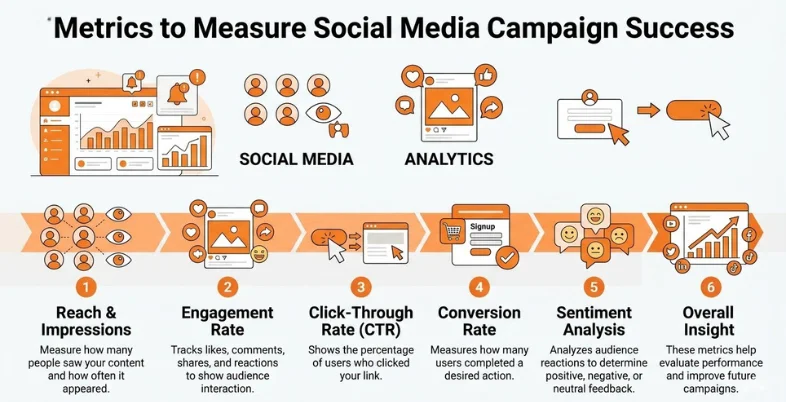
1. Reach and Impressions:
- Reach is the number of unique users who viewed the content in your campaign, and impressions are the number of times that the content was shown, which would make a brand know how visible its campaign was.
- For Example: If a campaign post on Instagram reaches 50,000 users and records 120,000 impressions, it means many users viewed the content multiple times.
2. Engagement Rate:
- Engagement rate demonstrates the extent to which people can be engaged with the content by commenting, liking, sharing, and reacting, which can reveal the attractiveness of the campaign to the audience.
- For Example: A campaign post on Facebook receives 2,000 likes, 300 comments, and 150 shares, indicating strong audience engagement.
3. Click-Through Rate (CTR):
- CTR is a statistic that is used to determine the percentage of users who have clicked on a link in the campaign post or advertisement, and this would allow businesses to evaluate the effectiveness of the call-to-action.
- For Example: A promotional ad on LinkedIn receives 10,000 views and 500 clicks, resulting in a 5% CTR.
4. Conversion Rate:
- Conversion rate is used to monitor how many people have performed a result they wanted to achieve, which may be buying a product, registering for a newsletter or applying.
- For Example: Out of 500 users who clicked a campaign link from Instagram, 50 purchased a product, resulting in a 10% conversion rate.
5. Sentiment Analysis:
- Sentiment analysis is used to investigate reactions and comments of the audience with the aim of assessing whether the perception of the campaign is good, bad or neutral.
- For Example: Comments on a campaign video on YouTube are mostly positive, with users praising the product and sharing their experiences.
Common Mistakes to Avoid in Social Media Campaigns
- Lack of Clear Goals: Carrying out campaigns without purpose may result in low outcomes, as there is no direction to follow or goals of success that can be measured.
- Negligence towards Audience Preferences: Unless brands have the knowledge of the interests and behaviour of their audience, the campaign will not reach the target users.
- Overly Promotional Content: Too many promotional posts might dishearten users, as they would rather use entertaining, informative, or relatable content on social media.
- Poor Timing: The campaigns should be launched at the appropriate time, i.e. when people are not busy, i.e. when no season will be relevant.
- Not Measuring Performance: Businesses unable to analyse campaign metrics will not know what worked, what did not and how to make future campaigns better.
Best Practices on a Successful Social Media Campaign
- Focus on Storytelling: Compelling stories are useful because they allow brands to emotionally resonate with audiences and are more memorable than campaigns that do not use compelling stories.
- Promote Local interaction: Connecting users to comment, share or create results in better relationships with the brand community.
- Leverage Trending Topics: The trending hashtags, challenges, or cultural moments would help to gain more reach and visibility for the campaign.
- Ensuring Constant Branding: Regular texts, colour scheme, and a tone of all campaign posts enhance brand awareness.
- Give Analytics to Get Better: Periodically reviewing the performance of a campaign assists a marketer in making adjustments to strategies that yield better outcomes.
- Test Long-Short Video Material: The videos that are very appealing and, in this case, have a higher reach and engagement include short videos like reels, TikTok clips, and YouTube Shorts.
Future Trends in Social Media Campaigns
- Artificial Intelligence-based Campaign Building: The use of artificial intelligence to create ideas on content to post, schedule postings, and analyse audience is becoming a common practice to increase campaign results.
- Individualised Marketing Experiences: The brands are employing data and algorithms to generate personalised messages in campaigns that reflect the preferences of the users.
- Engaging and Experiential Content: Such technologies as augmented reality (AR), filters, and interactive polls can engage the audience in campaigns.
- More Influencer and Creator Co-operations: Influencers and other digital creators are collaborating with brands to deliver content to niche audiences and gain trust.
- Short-Form Video Dominance: Social platforms are still dominated by short-form videos due to their easy consumption, high engagement, and increased chances of becoming viral.
Conclusion
Another crucial aspect of online marketing today is social media campaigns. Social media campaign examples show how brands strategically use platforms to achieve specific marketing goals. In comparison to ordinary postings on social media, campaigns are planned on-demand events that are intended to fulfil a set objective that could be raising brand awareness, enhancing engagement, generating leads, or selling new products. Social media campaigns can help brands reach their audience, build strong communities, and create memorable brand experiences when executed properly.
To businesses and marketers, the moral of the blog is to know their audience, ensure that they have a purpose, and explore new ideas. Companies can come up with effective social media campaigns that attract attention and produce significant outcomes by learning from successful campaigns and adjusting them to their brand identity.
FAQs
1. What then is a Social Media Campaign?
A social media campaign is a structured marketing initiative that is implemented via one or more social platforms during a particular time in order to attain objectives like brand recognition, involvement or sales.
2. What is the Difference Between a Social Media Campaign and a Normal Posting?
Daily posting keeps an online brand in the social media space, whereas a campaign is a specific effort with an intended purpose, theme, deadline, and quantifiable results.
3. Which are the Most Appropriate Platforms to be Used to Conduct Social Media Campaigns?
The most appropriate platforms will be based on the target audience. B2C campaigns can be done using Instagram, TikTok, and Facebook, whereas LinkedIn can be more efficient in B2B campaigns.
4. What is the Duration of a Social Media Campaign?
The majority of campaigns take a period of a few weeks to three months, based on the purpose, type of campaign, and marketing plan.
5. What is Successful About a Social Media Campaign?
An effective campaign typically consists of a clear goal, creative content, audience engagement, good storytelling, and tracking the performance.