Small Business SEO refers to the process of optimizing a small business website to improve its visibility on search engines like Google. It focuses on helping local and niche businesses attract the right audience, generate organic traffic, and compete with larger brands without spending heavily on ads.
Many small business owners find it difficult or even impossible to consistently receive traffic from Google. Even if you have an excellent product or website, it is difficult to expand if customers are unable to locate you online. That’s exactly how SEO becomes important: it makes your company appear when potential customers are already looking for what you have to offer.
This blog will provide you with how to target relevant keywords, increase the visibility of your website, and provide content that attracts real customers.
What is Small Business SEO?
Small business SEO involves optimizing the online presence and the website of a small business in a manner that it can be shown higher in search engine rankings, such as Google. The primary objective is to make the potential customers locate the business whenever they are online searching for related products or services.
Small business SEO does not coincide with paid ads. Paid advertisement has the ability to make your business appear on the first page of the search results in a second, but the traffic usually ceases after the budget is depleted. It operates under many key aspects. Keywords assist the search engine in knowing what your business entails.
The content contains helpful information that addresses the queries of the customers. Optimization enhances the structure of the websites, the speed of the pages, the titles, and the user experience. All these combined contribute to the success of the search engines in their faith in your site, and in presenting it to the appropriate audience.
Why SEO Matters for Small Businesses?
SEO is relevant to small businesses since it enables them to reach the appropriate customers at the time they are concentrating on the relevant products or services. The following are the main reasons as to why SEO is important to small businesses:
- Economical marketing plan: One of the most cost-effective methods of marketing a small business is through SEO. Rather than having to pay over and over again to place an advert, SEO will assist your site to get traffic automatically via search engines. It might require some time to reach the results, but when your pages start ranking, they can generate traffic without spending on ads all the time.
- Around-the-clock visibility and lead generation: SEO works all day and night. Your site will be posted on the search results list even when you are out of business. It is like your customers can learn about your products or services, visit your site, and get in touch with you at all times, which will assist in creating leads on a continuous basis.
- Establishes brand equality and confidence: Being listed high in search engines, your business usually turns out to appear more reliable and professional to people. Good rankings, useful content, and well-optimized sites contribute to the creation of a strong brand image and the development of customer confidence.
- Long-term results vs paid ads: Ads cause a cessation of traffic immediately the budget is exhausted. SEO is unlike this since its outcomes can last a long time. A highly ranked page may keep drawing people over a period of months through frequent updates and the optimization of the page.
- Search demand: The greatest rationale of why SEO is important is the fact that people are already looking at what you provide to them. SEO is useful in making your business visible to those users when they want it the most, thus it is likely to receive clicks, inquiries, and sales.
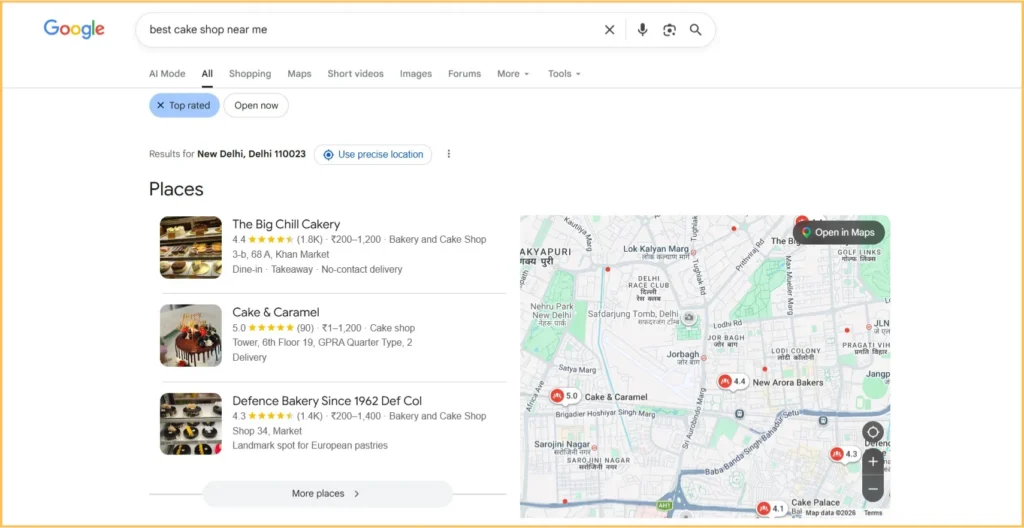
Example: Suppose you own a bakery. To appear in local searches like “best cake shop near me,” you first need to list your business on Google Business Profile. Once your profile is properly set up and optimized with correct details, photos, and reviews, Google can show your bakery in local results and Google Maps. This makes it much easier for nearby customers to find your shop, check your ratings, view your products, and contact or visit you. With good optimization and positive customer reviews, your bakery has a higher chance of appearing at the top, increasing visibility, trust, and daily customer inquiries.
How Search Engines Work?
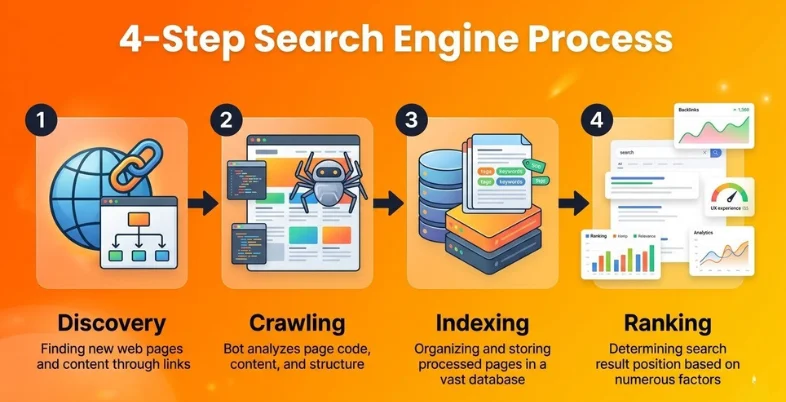
To provide accurate and relevant search results, search engines like Google adopt an organized four-step procedure. It all starts with discovery, where search engines are made aware of new content by finding updated or new web pages through links, sitemaps, or direct submissions. After a page is found, the process proceeds to crawling, in which bots visit the page and examine its technical components, content, and structure to determine its purpose. The next step is indexing, which involves storing and organizing the page in a large database according to its overall quality, keywords, and relevancy. Finally, ranking takes place, where the search engine determines the position of the page in search results by evaluating various SEO factors such as content quality, backlinks, user experience, and search intent, ensuring that users see the most useful and relevant information first.
Keywords are significant in this process. They assist the search engines in knowing the contents of your page. As the content that users are seeking is the one that you are providing,g then you have high chances to rank higher. Relevance does not only refer to how the search engines look into the quality of content and backlinks. The content with high quality and useful, clear, and accurate information has a better chance of ranking well. The links that are on other websites referring to your page are known as backlinks, and they serve as a sign of trust and authority.
Small Business SEO vs Local SEO
| Basis | Small Business SEO | Local SEO |
| Meaning | Focuses on improving a small business’s visibility in general search results. | Focuses on improving visibility in location-based search results. |
| Target Audience | Reaches a broader audience, which may be local, national, or even global. | Reaches people searching for products or services in a specific area. |
| Search Intent | Targets general, informational, and product-related searches. | Targets “near me” and city- or area-specific searches. |
| Business Type | Best for online businesses, service providers, and small brands wanting wider reach. | Best for physical stores, clinics, restaurants, salons, and local service businesses. |
| Keywords Used | Uses broader keywords like “best handmade candles” or “affordable accounting software.” | Uses location-based keywords like “handmade candles in Delhi” or “accountant near me.” |
| Competition Level | Often higher because businesses may compete with many websites across larger markets. | Usually limited to businesses within the same local area. |
| Main Goal | To increase overall organic traffic and online visibility. | To attract nearby customers and drive local visits, calls, or inquiries. |
| Important Factors | Website content, keyword optimization, backlinks, technical SEO, and user experience. | Google Business Profile, reviews, local citations, map visibility, and NAP consistency. |
| Results | Helps build long-term online presence and reach more people. | Helps generate quick leads from users ready to visit or contact a business. |
| Example | A small online clothing brand ranking for “best cotton kurtis for women.” | A boutique ranking for “women’s boutique near me” or “boutique in Jaipur.” |
Why Both Matter
The majority of small businesses require both strategies, along with the use of effective SEO tools to maximize results. For example, Local SEO can help a bakery rank at the top of search results when someone searches for “bakery near me,” while Small Business SEO focuses on broader queries like “best custom cake designs.” By using SEO tools for keyword research, performance tracking, and optimization, businesses can improve their visibility more strategically. This approach allows the bakery to attract both nearby customers and users searching online for valuable information, ultimately increasing reach and potential sales.
Key Elements of Small Business SEO
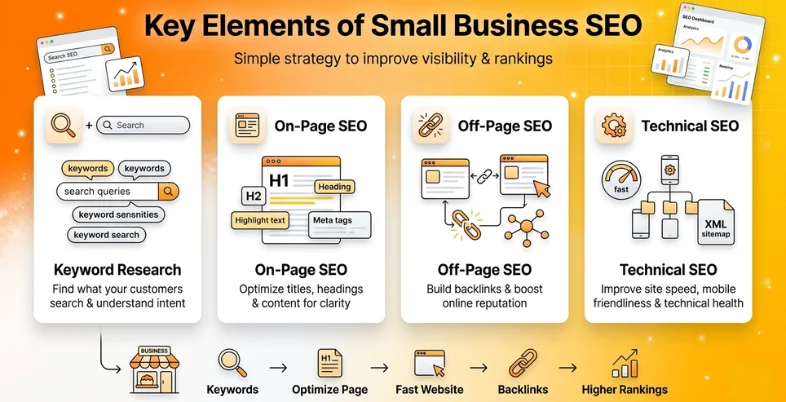
Small business SEO comprises some critical aspects that interact with one another in order to enhance the visibility of your webpage in the search engine. All these elements have varying functions in making your business appeal to the right audience and to be ranked higher in search engines.
1. Keyword Research
The research of keywords is a method of establishing the words and phrases that your possible customers are using as their search terms on the web. It makes you know what people desire, how they search for products or services like yours. This closely relates to search intent, which implies knowing the intent of a search.
As a case in point, a person who types in the best bakery near me is most likely interested in purchasing in the near future, whereas a person who types in the query on how to choose a birthday cake wants to get information. Such tools as Semrush, Google Keyword Planner, and Google Search Console are used to help businesses to find helpful keywords, search volume, and competition.
2. On-Page SEO
On-page SEO involves the optimization of the content and layout of the single pages on your site. This incorporates composing concise title tags and meta descriptions, the correct use of headings, and the placement of keywords in the text where they belong. It also entails the preparation of high-quality content that is useful, relevant, and easy to read. On-page SEO is good to make search engines know your page, and to enhance the experience of the visitors.
3. Off-Page SEO
Off-page SEO is the activity that is done off your site to enhance its power and reputation. Among the most significant aspects is the role of backlinks, which are the links of other websites that refer to your pages. Such links are indicators of trust and credibility. Online presence is also solidified by brand mentions and online references. These aspects combined create power and are likely to be ranked on top of search engines.
4. Technical SEO
Technical SEO is concerned with the technical side of the performance of your site. It makes sure that your site is not only easily accessible to the search engines but also to the users. Such aspects as the speed of the website, since visitors are likely to get impatient with the slow-loading pages, mobile-friendliness (as many users browse via smartphones), and the HTTPS security (which secures the data of users and helps build confidence) are important considerations. An effective site is one that is technical in nature, has a positive ranking, and is easy to use.
Example:
Take the case of a small bakery that you own. Searching for keywords aids in getting phrases such as custom cakes in Jammu. On-page SEO assists you in optimising your page for that keyword. Technical SEO will make sure your site loads in a short period of time and is mobile-friendly. Off-page SEO can assist your bakery in acquiring backlinks in the local blogs or food directories. All these things combined will make your business easier to locate on the Internet.
Step-by-Step Small Business SEO Strategy
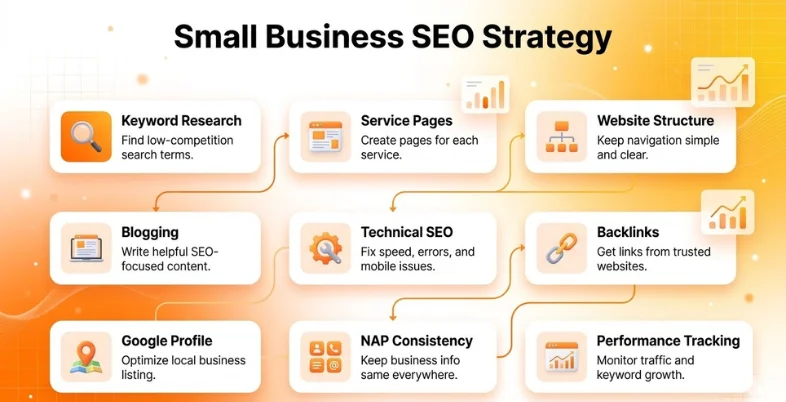
An effective small business SEO plan cannot be constructed within a day. It is a series of steps that can be applied practically to make your business visible in search results, attracting appropriate visitors, and turning them into customers. The following will be a step-by-step strategy that will be easier to follow with examples given to make every point clearer:
1. Find the Right Keywords
The initial one is to determine what words and phrases your potential customers are entering in Google. Begin by brainstorming on what one would search for when he or she is seeking your product or service. Then, authenticate those ideas with the help of keyword tools to identify terms with good search activity and reduced competition. In small businesses, low-competition keywords are feasible as they are easier to achieve high rankings.
Example: When you are the owner of a bakery, a competitive word such as cakes can be too much, but more specific words, such as custom birthday cakes in Jammu, could be easier to target.
2. Create Service Pages
There should be a page on your site that is dedicated to each major product or service. This aids the search engines in having a clear picture of what your business is and enables the customers to find what exactly they need. The page title and headings, as well as the content, should use keywords in a natural manner.
Example: A bakery is able to make separate pages when it comes to birthday cakes, wedding cakes, personalized cupcakes, and online cake delivery rather than putting all the information on one page.
3. Improve Website Structure
The site structure gives your site an easy-going navigation for the user and the search engines. Your navigation needs to be straightforward, simple, and well-structured to ensure you have visitors who can find critical pages in a short time. It is also achieved through a clean structure in order to have search engine bots crawl and index your pages more easily.
Example: A bakery website ought to include a menu consisting of home, about us, cakes, custom order, blog, and contact.
4. Start Blogging
Blogging will be effective in drawing organic traffic by responding to the queries of customers and offering helpful information. Learning material assists you in focusing on informational keywords and gaining credibility among your audience. In the long run, blog posts will attract individuals who are likely to be paying customers.
Example: A bakery can write blogs such as How to choose the best birthday cake or Top 5 cake trends at a wedding.
5. Fix Technical Issues
Technical issues may prevent your site from doing well in search engine results. The site audit tasks can be performed in a simple way in terms of checking broken links, slow pages, missing meta tags, duplicate pages, and problems with mobile usage. These are the most frequent problems that have to be fixed to enhance the search engine crawling and user experience.
Example: When your bakery site loads too slowly on mobile, you will lose customers fast, and that will negatively affect ranking and inquiries.
6. Build Backlinks
Backlinks refer to the links of other websites to your website, and they build authority in the search engines. The initial action that can be taken by small businesses is to register their site in reputable directories, associate with local companies, and be covered in blogs, newspapers, or local websites.
Example: The bakery can receive backlinks on the site of a local event planner, the business directory of the city, or a food blogger visiting local cake shops.
7. Google Business Profile Optimization.
Local SEO needs your Google Business Profile. Be sure to include all profile information, such as business name, address, phone number, web address, hours, category, and services. The photos should be regularly uploaded, the customer reviews should be collected, and updates should be posted to keep the profile active.
Example: When a bakery has fresh pictures of cakes, good ratings, and the right contact information, it will be found in local searches such as the cake shop near me.
8. Build NAP Citations
NAP is an abbreviation of Name, Address, and Phone Number. The information in your business online must be the same on all the online directories, social media pages, and review sites. Uniformity assists the search engines in having faith in your business information and also aids in enhancing the local ranking.
Example: When the phone number of your bakery is not the same on Facebook and Google Business Profile, it can be misleading to users as well as search engines.
9. Track Performance
Measurement of SEO should be done to ascertain what is working. The important indicators to monitor are the traffic to the site, the generation of leads, the ranking of the keywords, and backlinks. Performance monitoring is useful in enabling you to develop your strategy as time progresses and concentrate on what yields the best outcomes.
Example: In case your bakery realizes that the use of keywords such as custom cakes in Jammu is bringing more visitors and orders, you can generate additional content associated with that and optimize that service page to an even greater extent.
Importance of Content & E-E-A-T
Content plays a critical role in small business SEO, especially when aligned with a strategic B2B content marketing approach that targets decision-makers and industry-specific audiences. It helps search engines better understand your website while establishing authority and trust among potential business clients. High-quality, value-driven content supported by strong E-E-A-T signals enhances credibility, strengthens brand positioning, and drives long-term organic growth and search rankings in competitive B2B markets.
- Experience, Expertise, Authority, and Trust: E-E-A-T is used by search engines to determine whether your content is credible and useful to the users.
- User-friendly materials: The content must be authored in a way that achieves clarity in answering customer queries and resolves actual problems of customers.
- High quality leads to high results: Original, useful, and informative material will be better than weak material or copied material.
- Credibility leads to increased trust: With the addition of sources, testimonials, reviews, and real-life examples, your content becomes more believable.
- Coherent content develops authority: Advertising the content regularly and updating it keeps your site gaining authority over time.
Common SEO Mistakes to Avoid in Small Business SEO
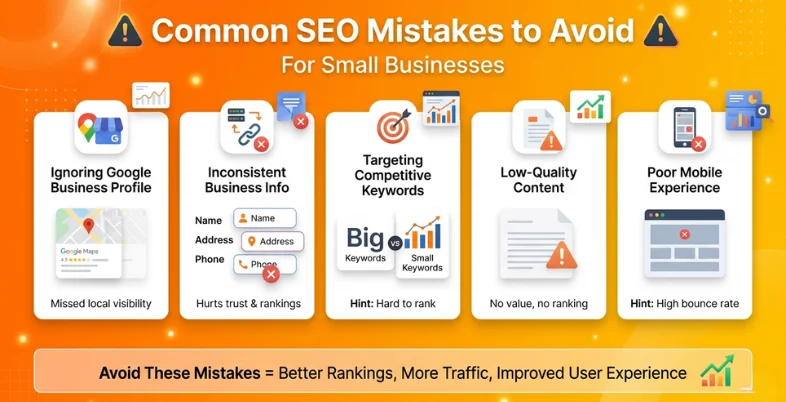
The reason behind many small businesses’ inability to cope with SEO does not imply that they are not trying, but rather they commit a few simple mistakes that minimize their search results and performance. The prevention of these problems can contribute to a rise in rankings, user experience, and online growth. One such often-overlooked strategy is leveraging UGC video platforms user-generated content that builds trust, drives engagement, and signals authenticity to search engines.
- Disregard of Google Business Profile: Claiming or optimizing a Google Business Profile is one of the biggest errors local businesses commit. This profile will make your business look good in local search results and Google Maps. In the event it is unfinished or unproductive, you may end up losing potential local customers who are seeking services in the immediate location.
- Poor business information consistency: The name of your business, address, and contact number should be the same on your website, Google profile, directories, and social media sites. The lack of consistency in information can disorient the search engines as well as the customers, which can undermine the local SEO performance and consequently undermine trust.
- The use of competitive keywords: Most small companies attempt to compete on broad and competitive keywords, which are hard to win. This will result in inadequate outcomes and futile efforts. Most of the time, it is more intelligent to hit smaller and less competitive keywords that are more suitable for your audience and services.
- Thin or low-quality content: It is dangerous to your SEO to publish weak, short, or copied content. Search engines reward useful, original, and relevant content to users. Poor web pages are not likely to rank high and can not retain visitors.
- Poor mobile experience: A site that fails to perform optimally on the mobile phone can send traffic away in a short period. The fact that many users are browsing on their phones means that a bad mobile experience will raise bounce rates and have a bad impact on rankings. Your site must be responsive, quick, and user-friendly across all screen sizes.
SEO in the Age of AI (AEO, GEO, AIO)
It is no longer confined to the so-called 10 blue links. Google AI features, chatbots, and generative search engines provide direct answers to users today, and this implies that small businesses have to not only optimize their search engines, but also their answer engines and AI experiences. The current directions of Google recommend placing the emphasis on useful and authoritative, people-friendly content that may be effective in the classic search and AI-based search features.
What is AEO (Answer Engine Optimization)?
It involves organizing content in such a way that enables platforms to grasp it fast and employ it to provide direct answers to user queries. AEO is not just about ranking a page, but making your content extractable, summarizable, and featured in featured snippets and voice search results and answers provided by artificial intelligence.
This is most likely to be effective when an organized form of content is provided in the form of questions and answers, simple words are used, and specific user queries are directly answered. To further strengthen your AEO strategy, using the right SEO tools plays a key role; exploring the best Ahrefs alternatives can help you find affordable options to track and optimize your answer-based content. Definitions of industry are slightly varied, but they always identify AEO to maximize on answer-based experience, and not just on link ranking.
What is GEO (Generative Engine Optimization)?
GEO is Generative Engine Optimization. It is devoted to making your content get found, mentioned, or quoted by artificial intelligence, Google AI Overviews, ChatGPT, Perplexity, and other similar platforms.
Where SEO can be used to rank pages and AEO can be used to make content a direct answer, GEO is related more to your brand and content being visible within the Artificial Intelligence-generated responses. It will involve the development of original, credible, well-organized content that AI systems can comprehend and can be sure to consult.
What is AIO (AI-driven Optimization)?
AIO typically is AI-driven optimization or AI optimization, a more general approach that applies AI technologies to enhance SEO processes and content performance. This may involve AIs in clustering of keywords, content planning, auditing a site, schema suggestions, internal linking ideas, and performance analysis.
Google cautions that it can break the spam policy and use generative AI to produce a large number of pages without providing any value. AIO must assist in quality support, rather than substitute originality and human judgment.
How to Adapt
Small businesses must begin to use conversational keywords to adjust to the AI age since users are no longer typing queries in short and unnatural formats. They must also prepare orderly content that has clear headings, frequently asked questions, step-by-step instructions, and brief answers that would make the page easier to understand by the search engines and the AI systems.
The most important thing is that businesses need to run towards originality. Google, in particular, suggests distinctive and non-commodity content that fulfills the actual user need, which is particularly critical in AI search experiences. Both SEO and AI visibility can be reinforced with first-hand experience, examples, reviews, professional knowledge, and credible information.
Example
Suppose you own a bakery. The conventional SEO will have your page ranking for a keyword such as custom birthday cakes in Jammu. AEO allows you to respond directly, in a structured manner, to a question like, What is the best cake flavor for a birthday party? GEO enables AI tools to refer to your bakery when somebody requests cake suggestions or different solutions in the area.
AIO is a better way to use AI tools to enhance your keyword research, content planning, and page optimization. These methods combined will ensure that your business is more discoverable in both search engines and AI-driven search engines.
30 Days SEO Action Plan for Small Business
A 30-day search engine optimization action plan allows small businesses a viable method of beginning to enhance their online presence without being intimidated. Rather than attempting to accomplish everything simultaneously, this plan divides the SEO into straightforward steps that can be performed on a weekly basis. The main points of each week are set in stone, i.e., setup, content, optimization, and tracking, so that you can have a solid base and progress in the right direction.
Week 1: Setup
The initial week is supposed to be devoted to establishing your SEO base. The first one is to build or enhance your Google Business Profile in order to have your business shown on local search engines and Google Maps. Check the business name, address, phone, website, and working hours. Second, conduct keyword research to know what words your customers are entering when they are searching for your products or services. Select the keywords that are relevant yet competitive. Another thing is that you should add your business to reputable online directories so that the search engines can ensure that the information about your business can be verified and enhance the visibility of your business.
Week 2: Content Creation
During the second week, you need to start generating content that will help you achieve your SEO objectives. To start with, create service pages for every product or service you provide. Every page must be clear about what you are offering, and your target keywords ought to be scattered naturally. and then write some useful blog posts depending on the questions raised by the customers or the frequent search terms in your sector. This not only aids in drawing the attention of the visitors who seek the information but also enhances the relevance of your site to the search engines.
Week 3: Optimization
The third week is on improving your website’s performance. Request the following: technical problems (poor page loading, broken links, missing meta titles, bad mobile design, or inaccessible crawling pages). By repairing these issues, you are ensuring that your site becomes user-friendly and that the search engines are able to reach it correctly. Considering this is also an opportune moment to begin developing backlinks through submitting your site to directories, making contact with other local partners, and acquiring mentions on other websites. These are backlinks that would enhance the authority of your site.
Week 4: Tracking
The last week will be about the measurement of SEO progress. Examine your web logs, how many inquiries or leads you have obtained, keyword positions, and backlinks that you obtained. This indicates what is going on and what requires a better approach. With the results, you will be able to optimize your plan, expand your weak pages, generate more useful content, and keep on with your SEO in the long run.
Example
Consider a small bakery you are in charge of. Week 1 is the week when you optimize your Google Business Profile, find keywords such as custom cakes in Jammu and enter your bakery into local directories.
Week 2 involves designing birthday cakes, wedding cakes, and same-day delivery of cakes, and a blog post on how to select the best cake design.
Week 3: You enhance the performance of your site and appear on a local food blog.
During Week 4, you will check the number of people who went to your site, called your business, or searched Google. This is a stage-by-stage plan that would make SEO an effective and manageable process.
How Long Does SEO Take?
SEO is not a quick tool; it takes time before it can yield any meaningful results. It provides sustainable traffic and growth in the long-term with the correct strategy and effort.
3–6 months: Initial results
The initial few months will be the months in which you can begin to see early returns in the form of improved keyword positions, enhanced traffic to the website, and improved visibility in search results. This step is based on the establishment of a solid base with the help of keyword research, the creation of the content, and simple optimization.
6–12 months: Growth phase
In 6-12 months, the process of SEO tends to gain traction. Your site can place in higher numbers of keywords, steady traffic, and leads or conversions. The content will start to do better, and the backlinks will assist in bettering your domain authority.
Importance of Consistency
SEO is a process that needs to be an ongoing activity. To ensure the rankings and improve them, it is necessary to update the content regularly, optimise the pages, correct the technical problems, and create backlinks. Intermittent efforts will delay or lead to declining rankings.
Conclusion
SEO must be regarded as a long-term investment and not a shortcut. Although it might not achieve high results in the short run, long-term benefits are sustainable and less expensive than paid advertising.
It is always a good thing to begin small and keep increasing.
Dwelling on such fundamental actions as researching the keywords, developing quality material, and optimizing your webpage. You can increase your strategy as you start to realize results.
FAQs
1. Can I do SEO on my Own as a Small Business Owner?
Yes, one can begin SEO independently with such basic knowledge as keyword research, writing content, and on-page optimization. But in case of more serious strategies, hiring an expert might be an option.
2. Is SEO Better than Paid Ads?
Both have their benefits. SEO offers long-term performance and organic traffic, whereas paid advertising offers rapid visibility. An amalgamation of the two is most appropriate for most businesses.
3. Why is my SEO not Giving Results within a Short Time?
SEO is time-consuming since search engines require crawling, indexing, and reviewing of your material. They are also influenced by competition, the quality of websites, and stability, which determines the speed of results.
4. What is the Frequency of Updating my Website to be SEO Friendly?
To support and enhance positioning, you need to update your site with new materials on a regular basis, optimize old pages, and address technical problems.
5. Which is the Factor of Most Importance in SEO?
No one particular thing, but quality content, use of relevant keywords, user experience, and good backlinks are all the ingredients to success.